Understanding Sustainability Claims In Construction
As sustainability and circularity considerations become increasingly important across construction projects, organisations are seeking greater visibility into the products and materials used throughout their supply chains.
As a result, supplier claims are receiving greater scrutiny than ever before.
Terms such as recyclable, reusable and recycled content appear throughout product brochures, tender submissions and supplier documentation. While these terms can provide useful information, they don't always tell the full story.
Increasingly, project teams are looking beyond simple environmental claims and asking deeper questions about material lifecycles, recovery pathways and end-of-life outcomes.
One term that frequently appears in these conversations is recyclable.
But what does recyclable actually mean?
And does recyclable automatically mean a product will be recycled at the end of its life? Not necessarily.

Why Are More Organisations Asking These Questions?
According to Australia's National Waste Report, the construction and demolition sector generated approximately 27 million tonnes of waste in 2020-21, making it one of Australia's largest waste-producing industries.
At the same time, sustainability considerations are becoming increasingly embedded within procurement frameworks, project sustainability objectives and supplier assessments.
Many organisations are now being asked to:
• Reduce waste to landfill
• Improve resource recovery
• Support circular economy outcomes
• Demonstrate environmental performance
As a result, understanding what happens to products and materials after use is becoming increasingly important.
The conversation is no longer focused solely on product performance and compliance. Increasingly, organisations are seeking greater visibility into how products may support broader sustainability outcomes throughout their lifecycle.
Source: DCCEEW National Waste Report.

Recyclable Doesn't Always Mean Recycled
One of the challenges with sustainability claims is that a recyclable label, while important, does not necessarily provide a complete picture of what will happen to a product at end-of-life.
A product may be classified as recyclable because the material itself can technically be recovered and reprocessed. However, whether that material is ultimately recycled often depends on factors beyond the product itself.
These may include:
• Available recycling infrastructure
• Collection systems
• Material separation processes
• Contamination levels
• Regional recycling capabilities
As Planet Ark's Recycling Near You program notes:
"Recycling services vary from council to council and state to state."
In other words, the existence of a recyclable material does not automatically guarantee that suitable collection and processing pathways are available in every location.
A product may be recyclable in theory, but without the right infrastructure, collection systems and recovery pathways, recycling may never occur.
Key Takeaway - A product being recyclable means recycling may be possible. It does not automatically mean recycling will occur.
.png&w=3840&q=85)
Why End-Of-Life Pathways Matter
This is one of the reasons many organisations are looking beyond simple environmental labels and asking more detailed questions about product lifecycles.
For example, two products may both be marketed as recyclable. However, one may have a well-established recovery pathway, while the other may rely on specialised facilities that are not widely available.
The objective is often to gain a clearer understanding of how different products align with project sustainability objectives, waste reduction targets and circularity goals.
In many cases, understanding the pathway can be just as important as understanding the material itself.
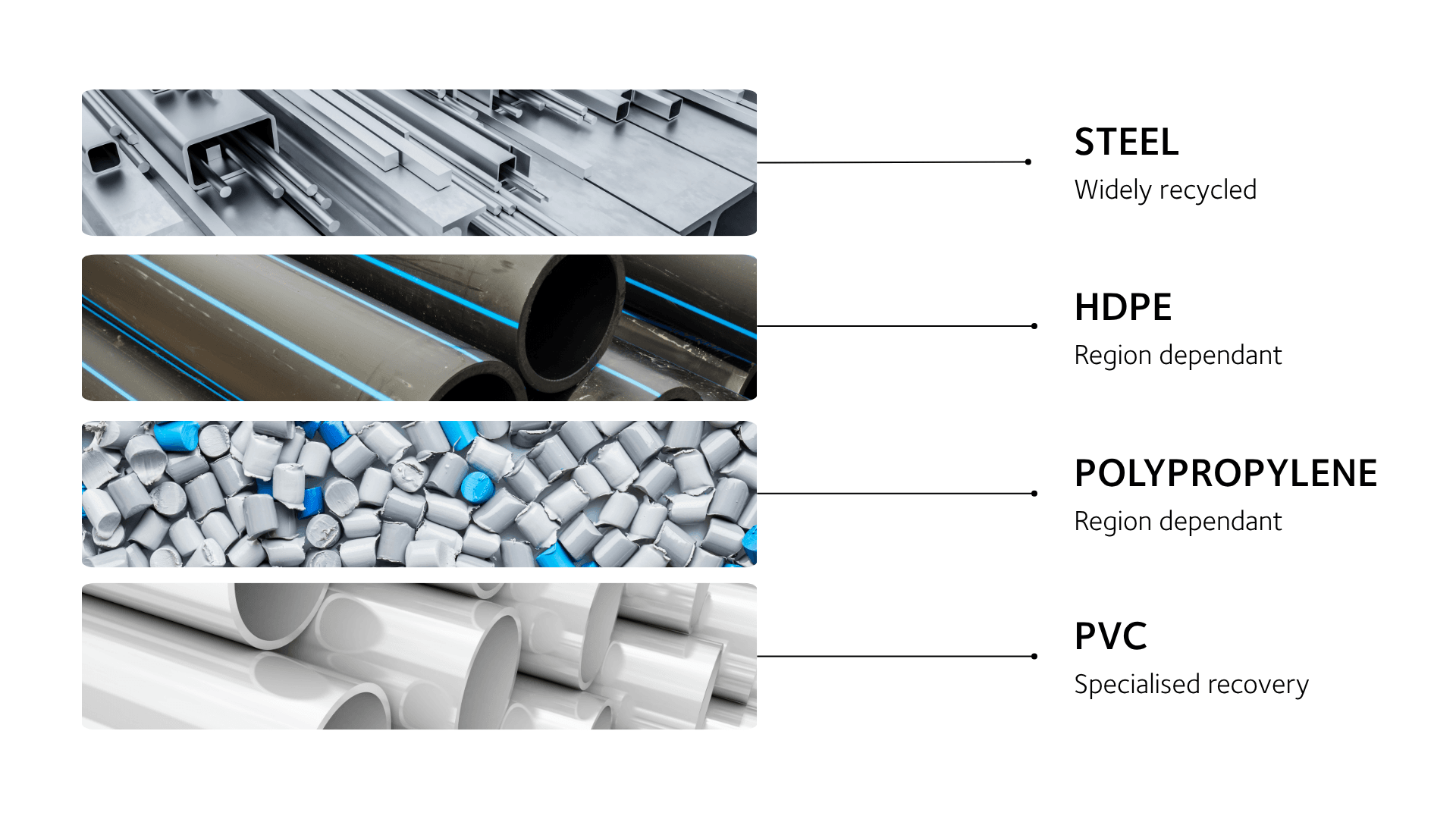
Not All Materials Follow The Same Pathway
One of the reasons recyclable claims can be difficult to compare is that different materials are handled differently.
Materials such as steel benefit from well-established recycling infrastructure throughout Australia. Other materials, including some plastics, may rely on different collection systems, specialised recovery processes or regional recycling capabilities.
As a result, two products may both be recyclable while having very different end-of-life outcomes.
Understanding the material is often only the first step. Understanding the pathway is where the picture becomes clearer.
Recyclable, Reusable And Recycled Content Are Not The Same Thing
Another challenge is that terms such as recyclable, reusable and recycled content are sometimes used interchangeably, despite describing very different outcomes.
Recyclable - Material can potentially be recovered and reprocessed.
Reusable - Product can be used multiple times before disposal
Recycled Content - Product contains material that has already been recovered.
Understanding these distinctions can help organisations evaluate supplier claims more effectively.For example, a reusable product may reduce waste generation before recycling even becomes necessary. Likewise, a product containing recycled content may support resource recovery objectives even if it is not reused during its service life.
Each contributes to sustainability outcomes in a different way.

Circularity Starts Before End-Of-Life
One of the core principles of the circular economy is that waste reduction should be considered long before a product reaches disposal.
Rather than focusing solely on recycling, circularity aims to keep materials in use for as long as possible through better design, reuse and recovery strategies.
The Green Building Council of Australia (GBCA) and Infrastructure Sustainability Council (ISC) both promote approaches that prioritise:
• Design out waste
• Extend product life
• Reuse opportunities
• Material recovery
• Design for disassembly
In practical terms, this means considering questions such as whether a product can be reused, whether it has a long service life, and whether there is a clear pathway for recovery once it reaches end-of-life.
A product's sustainability outcomes are often influenced well before recycling ever becomes necessary.
.png&w=3840&q=85)
Five Questions Worth Asking
When reviewing environmental claims, it can be helpful to look beyond the label itself and ask:
✓ What material is the product made from?
✓ Is there a recycling pathway available?
✓ Is recycling available locally?
✓ Can the product be reused before recycling?
✓ What happens when the product reaches end-of-life?
These questions often provide a more complete picture than a recyclable claim alone.
Our team is always happy to discuss product specifications, recovery pathways and supporting documentation where available, or explore our solutions: https://sitemax.com.au/sustainability